Durand, Texas
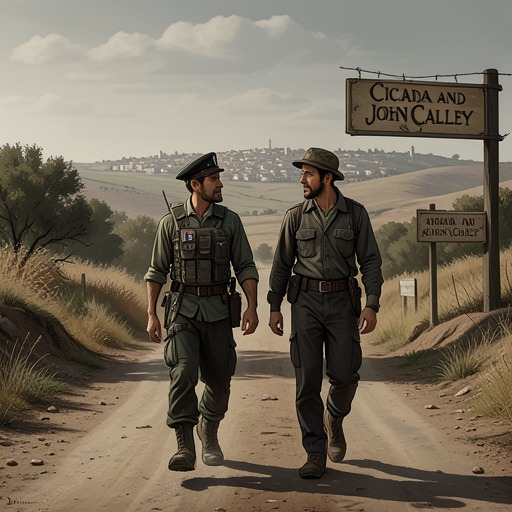
News of the WorldDurand, Texas, lies on the travelers’ southbound route from Indian Territory toward Castroville, Texas, and brings together the practical geography of their journey and the unsettled authority of Texas in 1870. Reached by the Lampasas Road after a self-made crossing of the Brazos River crossing, it is described as larger than the place they will bypass, with more people and, Jefferson Kyle Kidd hopes, money. Yet the town’s approach is marked not by dependable public institutions but by armed men who say that authority has fallen to them.
Route and River Crossings
The journey toward Durand follows a difficult crossing at the Brazos. At the ferry site, the ferry itself is absent; the landing is visible on the far bank, downstream, where the current would carry the wagon. The river is high, and Kidd has to reckon with possible changes to the landing, submerged sand and silt, and drowned trees turning below the surface. Rather than wait for a service that is not there, he loosens Pasha, and the mare Fancy plunges into the current. The travelers drift downstream but reach the opposite bank, where they are on the Lampasas Road.
That crossing changes the route: they will miss Meridian altogether. Kidd accepts the detour because Durand is larger and may offer a better chance to earn money. The decision gives the town a concrete place in the journey: it is not simply a destination, but a hoped-for stop along a road shaped by a river that has made ordinary passage uncertain. Rain follows, leaving drops on the live-oak leaves. Johanna Leonberger looks up into the canopy and rainy sky with cautious wonder, speaking softly in Kiowa about the water and the trees. The landscape that complicates travel also commands her attention.
An Armed Claim to Authority
Within a mile of Durand, Kidd sees riders approaching through the dripping live-oak forest. At his signal, Johanna falls silent. The men wear ragged clothes and shabby hats, but carry revolvers and new repeating carbines. Kidd stops the wagon and watches them steadily, uncertain what they want and wondering whether they have heard of the Great Brazos River Ten-Cent Shoot-out. His uncertainty reflects the broader condition he observes: in Texas in 1870, every man seems to do what is right in his own eyes.
The riders’ black-bearded spokesman asks where Kidd is headed. Kidd answers that he is going to Durand, but makes clear it is not his final destination. The exchange soon reveals the men’s claim to power. Another rider says that people who voted for Governor Davis will not be allowed into Erath County. Asked whether this is an official decision, the spokesman replies that there is no local administration: no sheriff, justice of the peace, mayor, or commissioners. He says Governor Davis and the United States Army removed the previous officials because they had served the Confederacy, and that no replacements were sent. The armed men, he says, have taken on the job and hold travelers accountable to them. They ask Kidd for a half-dollar.
Their authority is presented as a local assertion, not as an established office. The scene places a traveler and a child in the gap between formal government and armed self-appointed control. Johanna listens intently, her eyes wide, as Kidd pats her fingers. The small requested payment makes the threat immediate and ordinary at once: passage through the region may depend on the demands of men who openly admit that no local administration exists.
The Mill on the Bosque
After the encounter, the travelers reach a large broom and stave mill at the edge of the Bosque River. Cottonwoods stand along the water; their tiny new leaves tremble and glitter with rain, and Kidd notes that he has not seen cottonwoods for a long time. The river is shallow here, and they cross without difficulty. The contrast with the swollen Brazos is sharp: at Durand, the Bosque presents no comparable obstacle.
Inside the open-sided mill, an undershot wheel turns the machinery, lifting bright squares of water before spilling them back into the river. A worker sits beside a broom-making machine among heaps of broom-corn sheaves, with a pile of handles nearby. The shingled roof offers some protection from sun and rain. Chickens move calmly through the space as low clouds pass overhead. This working site, rather than a described civic building or inn, is where Kidd asks whether he and Johanna can shelter for the night. The evidence establishes the request, not whether they are granted permission.
Regional Setting and Significance
Durand sits within a wider landscape of uncertain travel and exposure to violence. Farther south, in the hill country, Kidd watches for raiders and considers abandoning the wagon so he can escape with Johanna on a packhorse. The account explains that Comanche raiders mostly came from the north, down from the Red River and across the open, arid country around Lampasas; farther south, the hill country offered concealment, water, isolated farms, and opportunities to raid without soldiers nearby. This is regional context rather than a specific description of an attack at Durand, but it clarifies why the roads and river crossings matter beyond their inconvenience.
The town’s narrative significance rests in its juxtaposition of ordinary work and exceptional insecurity. A river can be crossed easily or threaten to sweep a wagon away; a mill can provide a roof, while armed riders decide who may pass and demand payment. Durand is both a practical waypoint on the journey to Castroville and a point at which the political disorder surrounding that journey becomes unmistakable.